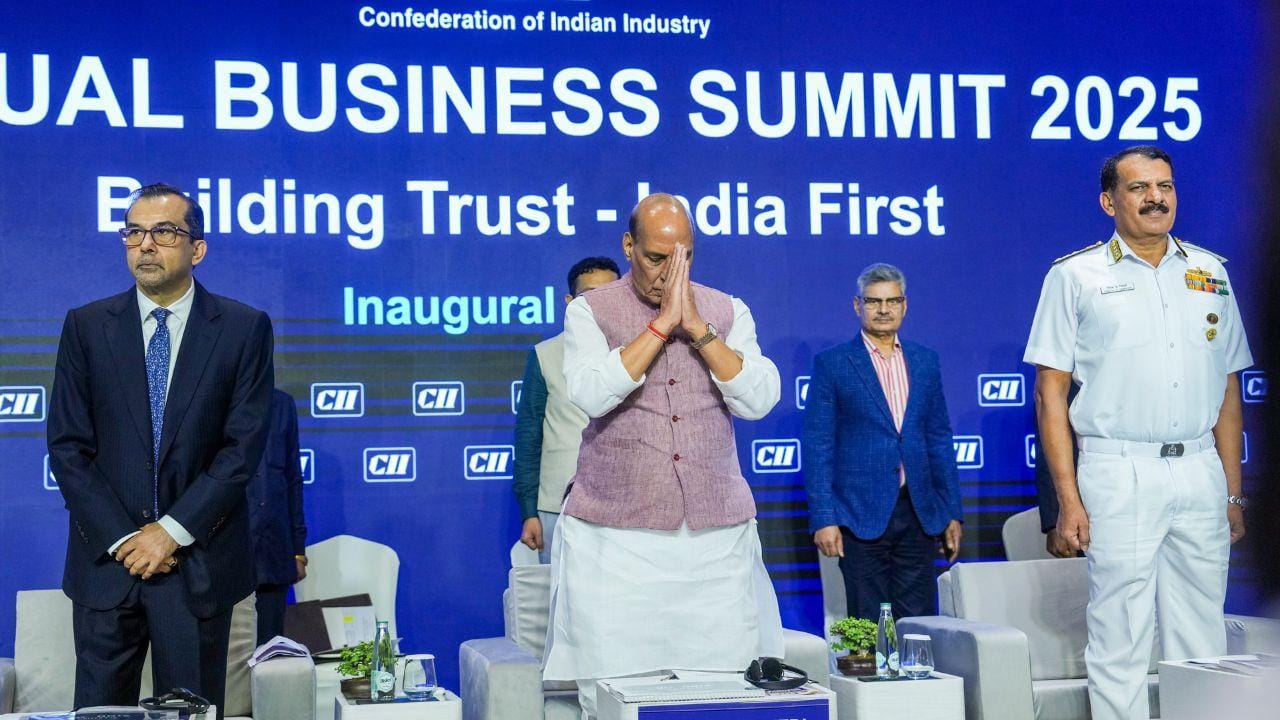
UPI a Global Game-Changer, GST a Model of Trust – Rajnath Singh at CII Summit 2025
📅 By Aaerm Law Associates | May 30, 2025
At the Confederation of Indian Industry (CII) Annual Business Summit 2025, Defence Minister Rajnath Singh praised India’s digital and tax reforms. He described Unified Payments Interface (UPI) as a “global game-changer”, and Goods and Services Tax (GST) as a “model of national economic integration” built on trust.
🔗 UPI: Leading the Global Digital Payment Revolution
Singh hailed UPI as a major milestone in India’s digital journey. According to him, UPI is more than a payment system—it reflects a behavioral transformation. People now trust and rely on digital methods for financial transactions, thanks to UPI’s security and convenience.
“UPI has earned the trust of citizens and businesses alike,” Singh stated. “Its success is so profound that many nations are now trying to adopt this model.”
📊 Between FY 2019–20 and March 2025, UPI transaction volume rose from ₹21.3 lakh crore to ₹260.56 lakh crore. This growth was fueled by government-backed incentive schemes, especially those focused on low-value transactions for small merchants.
Moreover, the Reserve Bank of India (RBI) continues to promote the use of UPI among rural and urban micro-enterprises. Singh emphasized that India’s digital leadership is not just technological—it is transformational.
🏛️ GST: Trust-Based Tax Reform
Shifting focus to GST, Singh explained that the system is not just a taxation model. Rather, it is a symbol of cooperative federalism and shared economic goals.
“GST is a unifying force. It brings together all states, union territories, and the Centre under one tax platform,” he said.
The Minister highlighted how GST has simplified tax compliance, reduced multiple tax layers, and improved transparency. These reforms enhanced the ease of doing business across India.
Additionally, the GST Council, with equal representation from the Centre and states, promotes collaboration. This structure has helped resolve disputes quickly and maintain consistency in tax policies.
🤝 Trust: The True National Asset
A key theme of Singh’s speech was trust. He described it as an emotional asset—more powerful than technical expertise or capital.
“A person may lack skill or resources, but if they are trustworthy, they become invaluable,” Singh declared.
He warned that global instability and conflict often arise from a trust deficit. In contrast, India fosters trust across social, economic, and political layers, contributing to stability and growth.
Singh pointed out that India’s success in reforms like UPI and GST stems from a foundation of trust—between the government and citizens, and among institutions and businesses.
📈 UPI and GST: Catalysts for Economic Growth
The combination of UPI’s digital penetration and GST’s structural reforms has driven India’s global economic emergence. Together, they:
- Increased financial inclusion.
- Made tax filing more efficient.
- Enhanced government revenue.
- Attracted global investors.
Both systems continue to evolve. Recent updates like UPI for feature phones, cross-border UPI, and GSTN data integration further improve functionality.
📍 CII Summit 2025: Focus on Growth and Innovation
The CII Summit serves as a forum for discussing India’s economic trajectory. In 2025, the emphasis was on technology, trust, and transparency.
Industry leaders, policy-makers, and economists at the event echoed Singh’s optimism. They stressed the importance of sustaining this momentum through:
- Policy consistency,
- Investment in infrastructure, and
- Continued digital innovation.
📝 Conclusion: Trust Fuels Transformation
Rajnath Singh’s address at the CII Annual Business Summit 2025 highlighted India’s bold reform journey. By embracing digital innovation through UPI and cooperative economic models like GST, India has built systems that are trusted, efficient, and scalable.
As the country continues to modernize, these reforms will play a central role in shaping India’s global leadership in technology, governance, and inclusive growth.