
Tax Refunds Under Direct Taxes, GST See Steady Rise in Q1; Net Collections Impacted
By Author | July 15, 2025
Income Tax Refund News – 2025 | GST & Taxation Update
Direct Tax Refunds Surge, Affect Net Collection
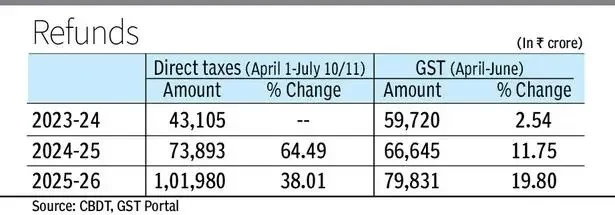
Refunds under direct taxes and GST have steadily increased during the April–June quarter over the last three fiscal years. While this trend supports taxpayers, it has affected net collections—especially at a time when gross tax collections have also slowed.
According to Income Tax Department data, gross tax collection between April 1 and July 10 stood at ₹6.65 lakh crore, up from ₹6.44 lakh crore, showing a modest growth of just over 3%. In contrast, tax refunds rose sharply to ₹1.02 lakh crore, compared to ₹74,000 crore, reflecting a 38% increase.
This jump came just a day after Finance Minister Nirmala Sitharaman highlighted the importance of speedy refund disbursements.
Why Corporate and Personal Refunds Are Rising
One tax expert explained that the rise in refunds can be viewed through two lenses: corporate and personal tax.
In the case of corporate taxes, refunds often result from lower profits and higher TDS deductions. While some attribute lower profits to depreciation from new capital investments, the expert believed a more accurate explanation lies in sluggish top-line performance. This aligns with muted corporate earnings for FY 2024–25. According to him, this isn’t encouraging news for the economy and may explain the significant relaxation in personal income tax slabs in Budget 2025—to boost consumption and business revenues.
On the personal tax side, the increase in refunds appears to stem largely from taxpayers switching regimes while filing ITRs, which resulted in tax savings and corresponding refunds.
GST Collections and Refund Trends
During the April–June quarter, gross GST collections stood at ₹6.22 lakh crore, up from ₹5.57 lakh crore last year—a growth of 11.8%. However, GST refunds rose nearly 20%, reaching ₹80,000 crore, up from ₹67,000 crore during the same period.
Another tax expert noted a shift in refund-to-collection ratios. The refund share dropped from 15.86% in Q1 FY22–23 to 12.82% in Q1 FY25–26. While refunds remain critical for MSMEs and exporters, this downward trend highlights an important shift.
Key Structural Reforms Behind the Trend
The government has taken significant steps to address inverted duty structures—where raw materials are taxed higher than finished goods. These corrections have reduced unnecessary refund claims.
“This change reflects a more mature and balanced tax environment,” the expert said. “By making the system fairer and more predictable, the government is building trust and long-term compliance among taxpayers. These reforms are critical to enhancing business confidence and ensuring India’s continued economic growth.”
