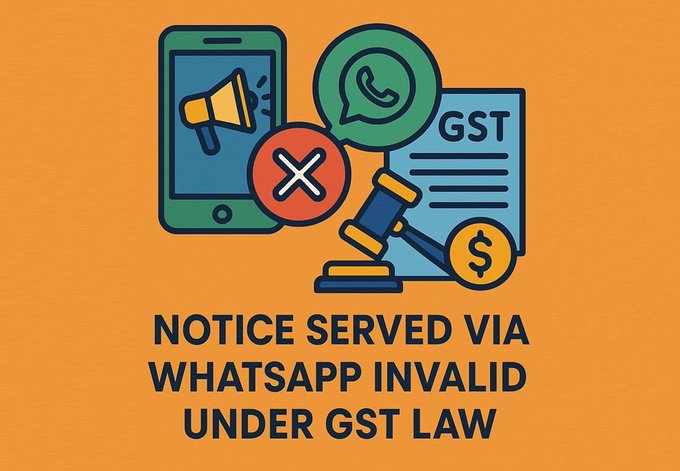
WhatsApp Service of Notice Invalid for Detention or Confiscation: Kerala HC
By Author / July 10, 2025
Kerala High Court, GST Judgments
Case Overview
In Mathai M.V. v. The Senior Enforcement Officer [WA No. 973 of 2025, dated June 24, 2025], the Kerala High Court ruled that any confiscation order under Section 130 of the CGST Act becomes invalid if authorities do not serve the notice through the legally prescribed methods.
Background of the Case
Mathai M.V., who owns truck KL-31 J-5759, challenged the seizure of his vehicle under Section 130 of the CGST Act, 2017. His vehicle had transported bilge water from INS Vikramaditya on November 23, 2024. Later, enforcement officials detained the truck and issued a confiscation order dated December 21, 2024, naming Petro Chemicals as the consignor.
According to Mathai, he never received the mandatory notice under Section 130. Instead, the authorities sent communications only via WhatsApp.
Arguments and Single Judge’s Findings
The Respondents argued that they had served the confiscation order through WhatsApp and that Mathai acknowledged its receipt on January 10, 2025. Based on this acknowledgment, a Single Judge dismissed the petition on April 11, 2025. He reasoned that the petitioner had effectively accepted the order and could not deny it afterward.
Grounds of Appeal
Mathai appealed the decision and asserted that WhatsApp is not a recognized method of service under Section 169 of the CGST Act. He insisted that authorities must follow formal statutory procedures. Without such compliance, any confiscation action remains legally flawed.
Issue for Consideration
Does service of a confiscation notice via WhatsApp satisfy the legal requirements under Section 130 of the CGST Act?
Key Observations by the High Court
The Court made several critical observations:
- Section 130(4) clearly requires the authorities to give the vehicle owner an opportunity to be heard before issuing any confiscation order.
- Mathai was the registered owner and consistently maintained that he did not receive a proper notice.
- The judges clarified that Section 169 of the CGST Act does not recognize WhatsApp as a valid service method.
- Although WhatsApp communication became widespread during the COVID-19 pandemic, it cannot replace formal service modes mandated by law.
Citations and Precedents
The Court relied on two previous decisions:
- M/s Lakshay Logistics v. State of Gujarat
- M/s Poomika Infra Developers v. State Tax Officer
In both cases, the courts nullified confiscation orders due to the improper method of serving notice under Section 169.
Final Ruling
The Kerala High Court held that the authorities had violated procedural requirements, which made the confiscation order invalid. As a result, the Court:
- Quashed the confiscation order dated December 21, 2024.
- Directed the Respondents to issue a new notice under Section 130.
- Instructed them to provide Mathai with a fair opportunity to present his case.
Conclusion
This judgment reinforces that strict compliance with statutory procedures is essential. While digital communication offers convenience, it cannot replace formal legal requirements under the CGST framework. The Kerala High Court reaffirmed that WhatsApp cannot serve as a legally valid method for delivering confiscation notices.