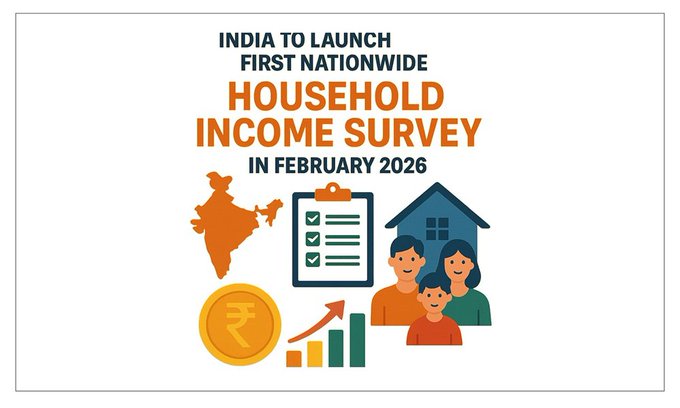
🇮🇳 India to Launch First Nationwide Household Income Survey in February 2026
By Author | June 30, 2025
Income Tax Recent News – 2025
🧾 Why the Survey Matters
India will launch its first-ever nationwide Household Income Survey in February 2026. The survey aims to close critical data gaps on income from salaries, agriculture, business, investments, and informal jobs. It promises much-needed clarity on income distribution, inequality, and tax planning.
🏢 Who Is Conducting the Survey?
The Ministry of Statistics and Programme Implementation (MoSPI) will oversee the survey through the National Sample Survey (NSS). Previous attempts in the 1950s, 1960s, and 1983–84 failed due to flawed methodologies and significant underreporting.
👨🔬 Who Is Behind the Methodology?
A Technical Expert Group (TEG) of eight members will guide the project.
Chaired by Dr. Surjit S. Bhalla, former IMF Executive Director and member of the PM’s Economic Advisory Council, the committee includes:
- Aloke Kar (Former ISI Kolkata Professor)
- Prof. Sonalde Desai (NCAER)
- Prof. Praveen Jha (JNU)
- Prof. Srijit Mishra (University of Hyderabad)
- Dr. Tirthankar Patnaik (Chief Economist, NSE)
- Dr. Rajesh Shukla (CEO, PRICE)
- Prof. Ram Singh (Director, Delhi School of Economics & MPC Member)
The group will define income categories, refine sampling strategies, and incorporate best practices from countries like USA, Australia, Canada, and South Africa.
📱 What Will Be New This Time?
Unlike earlier efforts, this survey will:
- Use digital tools for data collection
- Capture both formal and informal income sources
- Validate inputs using tax records
- Target wealthy and low-income households alike
If successful, it could provide accurate insights into the impact of reforms, welfare schemes, and digitalisation on household incomes.
🎯 How Will the Data Help?
The findings could:
- Help design targeted welfare schemes
- Differentiate low-income vs. low-expenditure households
- Improve tax policy formulation
- Fuel sharper debates around inequality, wage gaps, and class mobility
⚠️ What Are the Challenges?
Challenges include:
- Underreporting by wealthy households
- Difficulty tracking informal earnings
- Balancing privacy with data transparency
India’s vast informal economy and complex income structures pose real hurdles.
🌍 Global Context
- The United States relies on the Current Population Survey for similar data.
- South Africa uses household surveys to shape its progressive social policies.
India’s move is both timely and essential for a data-driven economy.